In 2027 there are 60 Taian (大安) days, 60 Tomobiki (友引) days and 61 Butsumetsu (仏滅) days. These are three of the rokuyo, the six-day cycle of lucky and unlucky days in the Japanese calendar, and Taian is the luckiest of the six. The first Taian of 2027 is Saturday, January 2 and the last is Wednesday, December 22. In all, 15 Taian days fall on a weekend or a Japanese public holiday, and there are none in July or August.
We worked out the dates in this article from the new moons and solar terms in the official calendar data for 2027 published by the National Astronomical Observatory of Japan (NAOJ, in Japanese), and checked that all 365 days match two other published rokuyo calendars. We also explain what the rokuyo mean, how they are set and how to see them in Google Calendar.
| Item | Details |
|---|---|
| Taian (大安) | 60 days (including 11 on weekends and 4 on weekday public holidays) |
| Tomobiki (友引) | 60 days |
| Butsumetsu (仏滅) | 61 days |
| Sensho, Senbu, Shakko | 61, 62 and 61 days |
| First and last Taian | Saturday, January 2 and Wednesday, December 22 |
| Taian on weekends and public holidays | 15 days (none in July or August) |
| Lunar New Year (day 1 of month 1) | Sunday, February 7, Sensho (先勝) |
| Leap month | None |
| Source of the calculation | New moons and solar terms in NAOJ’s Rekiyō (calendar data) for 2027, published on February 2, 2026 |
| How we checked | All 365 days match two published rokuyo calendars and Galna’s calculation (Mac version 1.1.4) |
When are the Taian days in 2027?
Here are the Taian days of 2027, month by month. Weekends and Japanese public holidays are in bold.
| Month | Taian days | Days |
|---|---|---|
| January | 2 (Sat), 13 (Wed), 19 (Tue), 25 (Mon), 31 (Sun) | 5 |
| February | 6 (Sat), 11 (Thu, holiday), 17 (Wed), 23 (Tue, holiday) | 4 |
| March | 1 (Mon), 7 (Sun), 11 (Thu), 17 (Wed), 23 (Tue), 29 (Mon) | 6 |
| April | 4 (Sun), 9 (Fri), 15 (Thu), 21 (Wed), 27 (Tue) | 5 |
| May | 3 (Mon, holiday), 7 (Fri), 13 (Thu), 19 (Wed), 25 (Tue), 31 (Mon) | 6 |
| June | 5 (Sat), 11 (Fri), 17 (Thu), 23 (Wed), 29 (Tue) | 5 |
| July | 9 (Fri), 15 (Thu), 21 (Wed), 27 (Tue) | 4 |
| August | 6 (Fri), 12 (Thu), 18 (Wed), 24 (Tue), 30 (Mon) | 5 |
| September | 4 (Sat), 10 (Fri), 16 (Thu), 22 (Wed), 28 (Tue) | 5 |
| October | 2 (Sat), 8 (Fri), 14 (Thu), 20 (Wed), 26 (Tue), 30 (Sat) | 6 |
| November | 5 (Fri), 11 (Thu), 17 (Wed), 23 (Tue, holiday), 28 (Sun) | 5 |
| December | 4 (Sat), 10 (Fri), 16 (Thu), 22 (Wed) | 4 |
Which Taian days in 2027 fall on weekends and public holidays?
These are the dates to look at for a wedding, a first meeting between two families or another event held on a day off. In 2027, 15 Taian days fall on a weekend or a Japanese public holiday. July and August have none.
| Date | Day | Public holiday |
|---|---|---|
| January 2 | Saturday | — |
| January 31 | Sunday | — |
| February 6 | Saturday | — |
| February 11 | Thursday | National Foundation Day |
| February 23 | Tuesday | The Emperor’s Birthday |
| March 7 | Sunday | — |
| April 4 | Sunday | — |
| May 3 | Monday | Constitution Memorial Day |
| June 5 | Saturday | — |
| September 4 | Saturday | — |
| October 2 | Saturday | — |
| October 30 | Saturday | — |
| November 23 | Tuesday | Labor Thanksgiving Day |
| November 28 | Sunday | — |
| December 4 | Saturday | — |
When are the Tomobiki and Butsumetsu days in 2027?
Custom says to avoid funerals on Tomobiki, and many people avoid celebrations on Butsumetsu. Here are the Tomobiki and Butsumetsu days month by month (weekends and public holidays in bold).
| Month | Tomobiki (友引) | Butsumetsu (仏滅) |
|---|---|---|
| January | 5 (Tue), 10 (Sun), 16 (Sat), 22 (Fri), 28 (Thu) | 1 (Fri, holiday), 7 (Thu), 12 (Tue), 18 (Mon), 24 (Sun), 30 (Sat) |
| February | 3 (Wed), 8 (Mon), 14 (Sun), 20 (Sat), 26 (Fri) | 5 (Fri), 10 (Wed), 16 (Tue), 22 (Mon), 28 (Sun) |
| March | 4 (Thu), 8 (Mon), 14 (Sun), 20 (Sat), 26 (Fri) | 6 (Sat), 10 (Wed), 16 (Tue), 22 (Mon, holiday), 28 (Sun) |
| April | 1 (Thu), 12 (Mon), 18 (Sun), 24 (Sat), 30 (Fri) | 3 (Sat), 8 (Thu), 14 (Wed), 20 (Tue), 26 (Mon) |
| May | 10 (Mon), 16 (Sun), 22 (Sat), 28 (Fri) | 2 (Sun), 6 (Thu), 12 (Wed), 18 (Tue), 24 (Mon), 30 (Sun) |
| June | 3 (Thu), 8 (Tue), 14 (Mon), 20 (Sun), 26 (Sat) | 10 (Thu), 16 (Wed), 22 (Tue), 28 (Mon) |
| July | 2 (Fri), 6 (Tue), 12 (Mon), 18 (Sun), 24 (Sat), 30 (Fri) | 8 (Thu), 14 (Wed), 20 (Tue), 26 (Mon) |
| August | 3 (Tue), 9 (Mon), 15 (Sun), 21 (Sat), 27 (Fri) | 1 (Sun), 5 (Thu), 11 (Wed, holiday), 17 (Tue), 23 (Mon), 29 (Sun) |
| September | 1 (Wed), 7 (Tue), 13 (Mon), 19 (Sun), 25 (Sat) | 3 (Fri), 9 (Thu), 15 (Wed), 21 (Tue), 27 (Mon) |
| October | 5 (Tue), 11 (Mon, holiday), 17 (Sun), 23 (Sat) | 1 (Fri), 7 (Thu), 13 (Wed), 19 (Tue), 25 (Mon), 29 (Fri) |
| November | 2 (Tue), 8 (Mon), 14 (Sun), 20 (Sat), 26 (Fri) | 4 (Thu), 10 (Wed), 16 (Tue), 22 (Mon) |
| December | 1 (Wed), 7 (Tue), 13 (Mon), 19 (Sun), 25 (Sat), 30 (Thu) | 3 (Fri), 9 (Thu), 15 (Wed), 21 (Tue), 27 (Mon) |
What are the rokuyo, and what does each day mean?
The rokuyo (六曜) are six days: Sensho, Tomobiki, Senbu, Butsumetsu, Taian and Shakko. They have long been printed on Japanese calendars as a rough guide to whether a day is lucky or unlucky. According to the National Diet Library’s online exhibition on the Japanese calendar (in Japanese), the rokuyo came to Japan from China around the 14th century and came into wide use only from the last years of the Edo period, in the mid-19th century. Interpretations vary, and there is no standard for which one is right. They are generally said to mean the following.
| Rokuyo | Reading | General meaning | How it is used |
|---|---|---|---|
| Sensho (先勝) | sensho, sakigachi | Lucky in the morning, unlucky in the afternoon. Good for getting things done quickly | Hold celebrations or sign contracts in the morning |
| Tomobiki (友引) | tomobiki | Lucky in the morning and evening, unlucky at noon. Read as “pulling a friend along”: fine for celebrations, but funerals are avoided | Avoid funerals; weddings are considered fine |
| Senbu (先負) | senbu, sakimake | Unlucky in the morning, lucky in the afternoon. A day to keep things quiet | Schedule events in the afternoon |
| Butsumetsu (仏滅) | butsumetsu | Unlucky all day. Funerals and memorial services are considered fine | Avoid weddings, registering a marriage and other celebrations |
| Taian (大安) | taian | Lucky all day. Especially good for weddings | Weddings, registering a marriage, contracts, moving house, picking up a new car |
| Shakko (赤口) | shakko, shakku | Lucky only around noon, unlucky in the morning and evening. Especially unlucky for celebrations | Hold celebrations around noon |
The rokuyo are a matter of tradition, and how much they matter differs from person to person, family to family and region to region. When you choose a date, it’s a good idea to check what your family or the other people involved think. For funerals, note that some crematoriums in Japan close on Tomobiki: for example, the Hamamatsu Crematorium run by Hamamatsu City is closed on Tomobiki and on New Year’s Day.
How are the rokuyo set?
The rokuyo are set by the month and day of the old Japanese lunisolar calendar. Add the lunar month and the lunar day and divide by 6: a remainder of 0 is Taian, 1 is Shakko, 2 is Sensho, 3 is Tomobiki, 4 is Senbu and 5 is Butsumetsu. For example, January 1, 2027 is day 24 of lunar month 11, so 11 + 24 = 35, and 35 divided by 6 leaves 5: Butsumetsu.
So day 1 of each lunar month always has the same rokuyo, and from there the cycle repeats in the order Sensho → Tomobiki → Senbu → Butsumetsu → Taian → Shakko. On the day a new lunar month begins, the order jumps.
| Lunar month | Rokuyo of day 1 |
|---|---|
| 1st and 7th | Sensho (先勝) |
| 2nd and 8th | Tomobiki (友引) |
| 3rd and 9th | Senbu (先負) |
| 4th and 10th | Butsumetsu (仏滅) |
| 5th and 11th | Taian (大安) |
| 6th and 12th | Shakko (赤口) |
On which days in 2027 does the order jump?
A lunar month begins on the day of the new moon, and which month it is depends on the chūki it contains: twelve of the 24 solar terms, such as Usui and Shunbun (the spring equinox). A month without a chūki becomes a leap month, but 2027 has no leap month. These are the days a lunar month begins in 2027, and the order of the rokuyo jumps on each of them.
| Date | Lunar date | Rokuyo that day | Rokuyo the day before |
|---|---|---|---|
| Friday, January 8 | Day 1 of month 12 | Shakko (赤口) | Butsumetsu (仏滅) |
| Sunday, February 7 | Day 1 of month 1 (Lunar New Year) | Sensho (先勝) | Taian (大安) |
| Monday, March 8 | Day 1 of month 2 | Tomobiki (友引) | Taian (大安) |
| Wednesday, April 7 | Day 1 of month 3 | Senbu (先負) | Sensho (先勝) |
| Thursday, May 6 | Day 1 of month 4 | Butsumetsu (仏滅) | Sensho (先勝) |
| Saturday, June 5 | Day 1 of month 5 | Taian (大安) | Senbu (先負) |
| Sunday, July 4 | Day 1 of month 6 | Shakko (赤口) | Senbu (先負) |
| Monday, August 2 | Day 1 of month 7 | Sensho (先勝) | Butsumetsu (仏滅) |
| Wednesday, September 1 | Day 1 of month 8 | Tomobiki (友引) | Shakko (赤口) |
| Thursday, September 30 | Day 1 of month 9 | Senbu (先負) | Shakko (赤口) |
| Friday, October 29 | Day 1 of month 10 | Butsumetsu (仏滅) | Sensho (先勝) |
| Sunday, November 28 | Day 1 of month 11 | Taian (大安) | Senbu (先負) |
| Tuesday, December 28 | Day 1 of month 12 | Shakko (赤口) | Butsumetsu (仏滅) |
A lunar month begins on the day of the new moon in Japan Standard Time. The new moon of February 2027 is at 0:56 on February 7 in Japan, when it is still February 6 in China (one hour behind Japan). If you work out the lunar calendar in China Standard Time, Lunar New Year falls on February 6, and the rokuyo for the 30 days from February 6 to March 7 are one step off from the Japanese calendar. If calendars or apps show different rokuyo in this period, compare them with the tables in this article.
Rokuyo calendar 2027 (all 12 months)
The rokuyo for every day of 2027. Weeks start on Monday, and Taian is in bold.
January 2027
| Mon | Tue | Wed | Thu | Fri | Sat | Sun |
|---|---|---|---|---|---|---|
| 1 Butsumetsu | 2 Taian | 3 Shakko | ||||
| 4 Sensho | 5 Tomobiki | 6 Senbu | 7 Butsumetsu | 8 Shakko | 9 Sensho | 10 Tomobiki |
| 11 Senbu | 12 Butsumetsu | 13 Taian | 14 Shakko | 15 Sensho | 16 Tomobiki | 17 Senbu |
| 18 Butsumetsu | 19 Taian | 20 Shakko | 21 Sensho | 22 Tomobiki | 23 Senbu | 24 Butsumetsu |
| 25 Taian | 26 Shakko | 27 Sensho | 28 Tomobiki | 29 Senbu | 30 Butsumetsu | 31 Taian |
February 2027
| Mon | Tue | Wed | Thu | Fri | Sat | Sun |
|---|---|---|---|---|---|---|
| 1 Shakko | 2 Sensho | 3 Tomobiki | 4 Senbu | 5 Butsumetsu | 6 Taian | 7 Sensho |
| 8 Tomobiki | 9 Senbu | 10 Butsumetsu | 11 Taian | 12 Shakko | 13 Sensho | 14 Tomobiki |
| 15 Senbu | 16 Butsumetsu | 17 Taian | 18 Shakko | 19 Sensho | 20 Tomobiki | 21 Senbu |
| 22 Butsumetsu | 23 Taian | 24 Shakko | 25 Sensho | 26 Tomobiki | 27 Senbu | 28 Butsumetsu |
March 2027
| Mon | Tue | Wed | Thu | Fri | Sat | Sun |
|---|---|---|---|---|---|---|
| 1 Taian | 2 Shakko | 3 Sensho | 4 Tomobiki | 5 Senbu | 6 Butsumetsu | 7 Taian |
| 8 Tomobiki | 9 Senbu | 10 Butsumetsu | 11 Taian | 12 Shakko | 13 Sensho | 14 Tomobiki |
| 15 Senbu | 16 Butsumetsu | 17 Taian | 18 Shakko | 19 Sensho | 20 Tomobiki | 21 Senbu |
| 22 Butsumetsu | 23 Taian | 24 Shakko | 25 Sensho | 26 Tomobiki | 27 Senbu | 28 Butsumetsu |
| 29 Taian | 30 Shakko | 31 Sensho |
April 2027
| Mon | Tue | Wed | Thu | Fri | Sat | Sun |
|---|---|---|---|---|---|---|
| 1 Tomobiki | 2 Senbu | 3 Butsumetsu | 4 Taian | |||
| 5 Shakko | 6 Sensho | 7 Senbu | 8 Butsumetsu | 9 Taian | 10 Shakko | 11 Sensho |
| 12 Tomobiki | 13 Senbu | 14 Butsumetsu | 15 Taian | 16 Shakko | 17 Sensho | 18 Tomobiki |
| 19 Senbu | 20 Butsumetsu | 21 Taian | 22 Shakko | 23 Sensho | 24 Tomobiki | 25 Senbu |
| 26 Butsumetsu | 27 Taian | 28 Shakko | 29 Sensho | 30 Tomobiki |
May 2027
| Mon | Tue | Wed | Thu | Fri | Sat | Sun |
|---|---|---|---|---|---|---|
| 1 Senbu | 2 Butsumetsu | |||||
| 3 Taian | 4 Shakko | 5 Sensho | 6 Butsumetsu | 7 Taian | 8 Shakko | 9 Sensho |
| 10 Tomobiki | 11 Senbu | 12 Butsumetsu | 13 Taian | 14 Shakko | 15 Sensho | 16 Tomobiki |
| 17 Senbu | 18 Butsumetsu | 19 Taian | 20 Shakko | 21 Sensho | 22 Tomobiki | 23 Senbu |
| 24 Butsumetsu | 25 Taian | 26 Shakko | 27 Sensho | 28 Tomobiki | 29 Senbu | 30 Butsumetsu |
| 31 Taian |
June 2027
| Mon | Tue | Wed | Thu | Fri | Sat | Sun |
|---|---|---|---|---|---|---|
| 1 Shakko | 2 Sensho | 3 Tomobiki | 4 Senbu | 5 Taian | 6 Shakko | |
| 7 Sensho | 8 Tomobiki | 9 Senbu | 10 Butsumetsu | 11 Taian | 12 Shakko | 13 Sensho |
| 14 Tomobiki | 15 Senbu | 16 Butsumetsu | 17 Taian | 18 Shakko | 19 Sensho | 20 Tomobiki |
| 21 Senbu | 22 Butsumetsu | 23 Taian | 24 Shakko | 25 Sensho | 26 Tomobiki | 27 Senbu |
| 28 Butsumetsu | 29 Taian | 30 Shakko |
July 2027
| Mon | Tue | Wed | Thu | Fri | Sat | Sun |
|---|---|---|---|---|---|---|
| 1 Sensho | 2 Tomobiki | 3 Senbu | 4 Shakko | |||
| 5 Sensho | 6 Tomobiki | 7 Senbu | 8 Butsumetsu | 9 Taian | 10 Shakko | 11 Sensho |
| 12 Tomobiki | 13 Senbu | 14 Butsumetsu | 15 Taian | 16 Shakko | 17 Sensho | 18 Tomobiki |
| 19 Senbu | 20 Butsumetsu | 21 Taian | 22 Shakko | 23 Sensho | 24 Tomobiki | 25 Senbu |
| 26 Butsumetsu | 27 Taian | 28 Shakko | 29 Sensho | 30 Tomobiki | 31 Senbu |
August 2027
| Mon | Tue | Wed | Thu | Fri | Sat | Sun |
|---|---|---|---|---|---|---|
| 1 Butsumetsu | ||||||
| 2 Sensho | 3 Tomobiki | 4 Senbu | 5 Butsumetsu | 6 Taian | 7 Shakko | 8 Sensho |
| 9 Tomobiki | 10 Senbu | 11 Butsumetsu | 12 Taian | 13 Shakko | 14 Sensho | 15 Tomobiki |
| 16 Senbu | 17 Butsumetsu | 18 Taian | 19 Shakko | 20 Sensho | 21 Tomobiki | 22 Senbu |
| 23 Butsumetsu | 24 Taian | 25 Shakko | 26 Sensho | 27 Tomobiki | 28 Senbu | 29 Butsumetsu |
| 30 Taian | 31 Shakko |
September 2027
| Mon | Tue | Wed | Thu | Fri | Sat | Sun |
|---|---|---|---|---|---|---|
| 1 Tomobiki | 2 Senbu | 3 Butsumetsu | 4 Taian | 5 Shakko | ||
| 6 Sensho | 7 Tomobiki | 8 Senbu | 9 Butsumetsu | 10 Taian | 11 Shakko | 12 Sensho |
| 13 Tomobiki | 14 Senbu | 15 Butsumetsu | 16 Taian | 17 Shakko | 18 Sensho | 19 Tomobiki |
| 20 Senbu | 21 Butsumetsu | 22 Taian | 23 Shakko | 24 Sensho | 25 Tomobiki | 26 Senbu |
| 27 Butsumetsu | 28 Taian | 29 Shakko | 30 Senbu |
October 2027
| Mon | Tue | Wed | Thu | Fri | Sat | Sun |
|---|---|---|---|---|---|---|
| 1 Butsumetsu | 2 Taian | 3 Shakko | ||||
| 4 Sensho | 5 Tomobiki | 6 Senbu | 7 Butsumetsu | 8 Taian | 9 Shakko | 10 Sensho |
| 11 Tomobiki | 12 Senbu | 13 Butsumetsu | 14 Taian | 15 Shakko | 16 Sensho | 17 Tomobiki |
| 18 Senbu | 19 Butsumetsu | 20 Taian | 21 Shakko | 22 Sensho | 23 Tomobiki | 24 Senbu |
| 25 Butsumetsu | 26 Taian | 27 Shakko | 28 Sensho | 29 Butsumetsu | 30 Taian | 31 Shakko |
November 2027
| Mon | Tue | Wed | Thu | Fri | Sat | Sun |
|---|---|---|---|---|---|---|
| 1 Sensho | 2 Tomobiki | 3 Senbu | 4 Butsumetsu | 5 Taian | 6 Shakko | 7 Sensho |
| 8 Tomobiki | 9 Senbu | 10 Butsumetsu | 11 Taian | 12 Shakko | 13 Sensho | 14 Tomobiki |
| 15 Senbu | 16 Butsumetsu | 17 Taian | 18 Shakko | 19 Sensho | 20 Tomobiki | 21 Senbu |
| 22 Butsumetsu | 23 Taian | 24 Shakko | 25 Sensho | 26 Tomobiki | 27 Senbu | 28 Taian |
| 29 Shakko | 30 Sensho |
December 2027
| Mon | Tue | Wed | Thu | Fri | Sat | Sun |
|---|---|---|---|---|---|---|
| 1 Tomobiki | 2 Senbu | 3 Butsumetsu | 4 Taian | 5 Shakko | ||
| 6 Sensho | 7 Tomobiki | 8 Senbu | 9 Butsumetsu | 10 Taian | 11 Shakko | 12 Sensho |
| 13 Tomobiki | 14 Senbu | 15 Butsumetsu | 16 Taian | 17 Shakko | 18 Sensho | 19 Tomobiki |
| 20 Senbu | 21 Butsumetsu | 22 Taian | 23 Shakko | 24 Sensho | 25 Tomobiki | 26 Senbu |
| 27 Butsumetsu | 28 Shakko | 29 Sensho | 30 Tomobiki | 31 Senbu |
How can you see the rokuyo in Google Calendar?
Google Calendar has no setting to show the rokuyo. You can add a public calendar that publishes the rokuyo as an all-day event for every day (with “From URL”), but the rokuyo then sit in the same rows as your events, so in month view every day loses a line of space.
With Galna, a dedicated Google Calendar app for Mac and Windows, open the settings and turn on “Show Rokuyo (Lucky and unlucky days of the Japanese calendar)” under “App Settings”. The rokuyo then appear to the right of the date in month view and below the date in week view. Galna works out the rokuyo inside the app, so nothing is written to Google Calendar. The steps are shown with screenshots in “Show the Japanese rokuyo (Taian, Butsumetsu) in Google Calendar”.
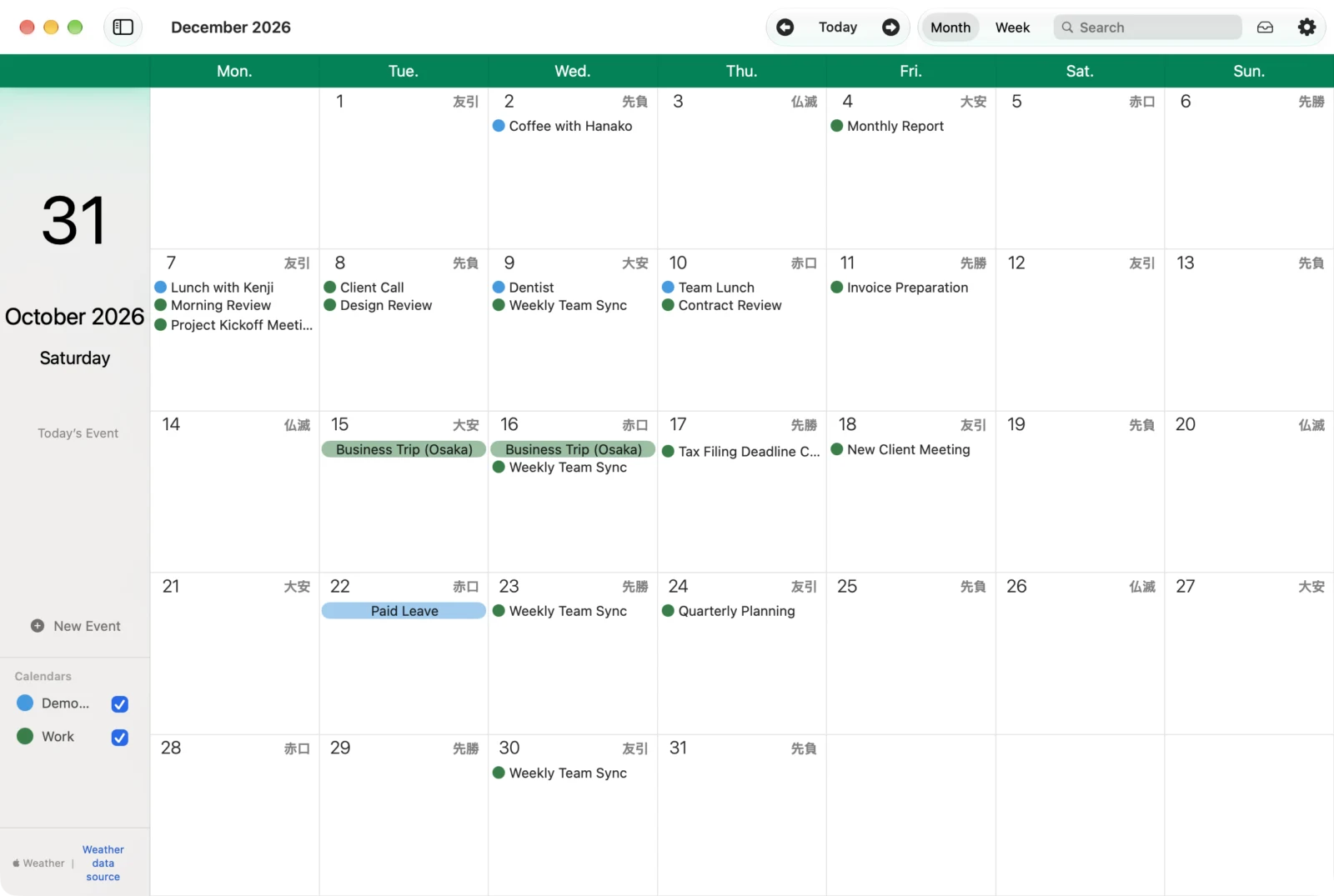
We ran Galna’s rokuyo calculation (Mac version 1.1.4) for all 365 days of 2027 and confirmed that every day matches the tables in this article. Galna works out the lunar calendar in Japan Standard Time, so February 6 to March 7 also follow the Japanese calendar. In Galna Calendar, the Windows version, turn on the rokuyo in the settings and they appear in month and week views.
Every feature of Galna is free for the first 7 days. After that, the Mac version is a one-time purchase or a monthly subscription, your choice (macOS 15 or later). The Windows version is a one-time purchase on the Microsoft Store, bought separately from the Mac version (Windows 11 version 22H2 or later). A Google account is required. Galna is not an official Google app.
Frequently asked questions
How many Taian days are there in 2027?
There are 60 Taian days in 2027. The first is Saturday, January 2 and the last is Wednesday, December 22. Of these, 11 fall on a weekend and 4 on a weekday public holiday (February 11, February 23, May 3 and November 23).
Which weekend days in 2027 are Taian?
The 11 weekend Taian days are January 2 (Sat), January 31 (Sun), February 6 (Sat), March 7 (Sun), April 4 (Sun), June 5 (Sat), September 4 (Sat), October 2 (Sat), October 30 (Sat), November 28 (Sun) and December 4 (Sat). Taian also falls on 4 public holidays: February 11 (National Foundation Day), February 23 (The Emperor’s Birthday), May 3 (Constitution Memorial Day) and November 23 (Labor Thanksgiving Day).
When is Lunar New Year 2027 in the Japanese calendar?
In the Japanese lunar calendar it is Sunday, February 7, a Sensho day. Chinese New Year, worked out in China Standard Time, is one day earlier, on February 6.
Why do some calendars show different rokuyo?
Because they decide the start of a lunar month (the day of the new moon) in different time zones. The Japanese lunar calendar uses Japan Standard Time, but a calendar worked out in China Standard Time starts the month one day earlier when the new moon falls between 0:00 and 1:00 Japan time. In 2027 this affects the 30 days from February 6 to March 7, where the rokuyo are one step off.
Do I need to pay attention to the rokuyo?
The rokuyo are a tradition, and there is no fixed standard for what they mean. How much they matter differs from person to person, family to family and region to region, so decide together with your family or the people involved. For funerals, some crematoriums close on Tomobiki, so check the crematorium’s schedule too.
Can I show the 2027 rokuyo in Google Calendar?
Google Calendar itself has no way to show the rokuyo. In Galna, a dedicated Google Calendar app, turn on “Show Rokuyo” under “App Settings”, and the rokuyo appear next to the dates in month and week views. The 2027 rokuyo shown by the Mac version (1.1.4) match the tables in this article on all 365 days.
Summary
- 2027 has 60 Taian, 60 Tomobiki and 61 Butsumetsu days. 15 Taian days fall on weekends or public holidays, none of them in July or August
- The rokuyo are set by the lunar month plus the lunar day, divided by 6, and the order jumps when a new lunar month begins
- Lunar New Year 2027 in Japan is February 7. Worked out in China Standard Time, the rokuyo from February 6 to March 7 are one step off
- We calculated the dates from NAOJ’s official data and checked all 365 days against two other calendars
- Galna shows the rokuyo next to the dates of your Google Calendar